An Organic Traffic Growth Workflow for Scalable SEO Success
By Toy Wen Da, Co-Founder · Updated · 9 min read · scored 95/100
An organic traffic growth workflow for scalable SEO success is a repeatable, documented process that turns keyword research, content production, internal linking and reporting into one system your team can run without you. It replaces one-off ranking pushes with steps anyone can follow, measure and improve.
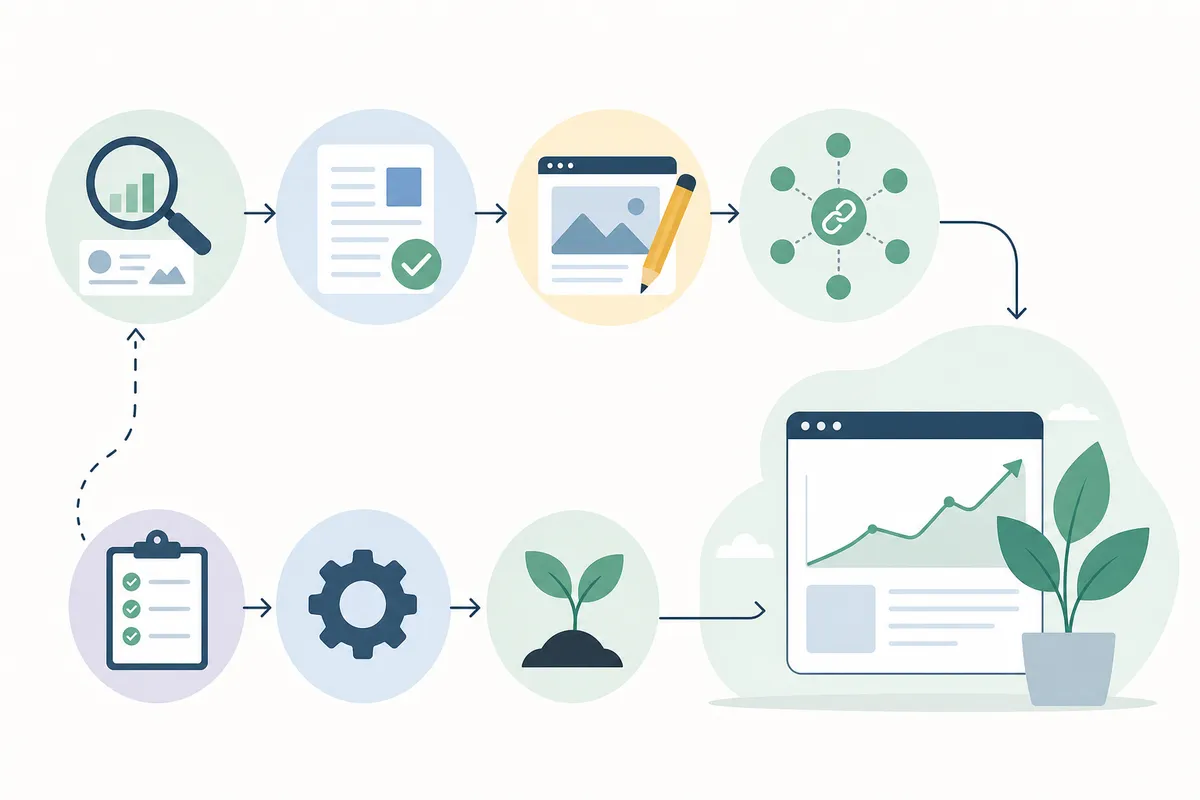
Most teams already do the individual tasks: they research keywords, write posts, build a few links and check rankings. What they lack is the connective tissue, meaning a documented order of operations, clear owners and checkpoints that catch mistakes before anything publishes. Without it, growth depends on one person's memory, and it breaks the moment that person is out sick or hands off the account.
Step 1: Audit and set a real baseline
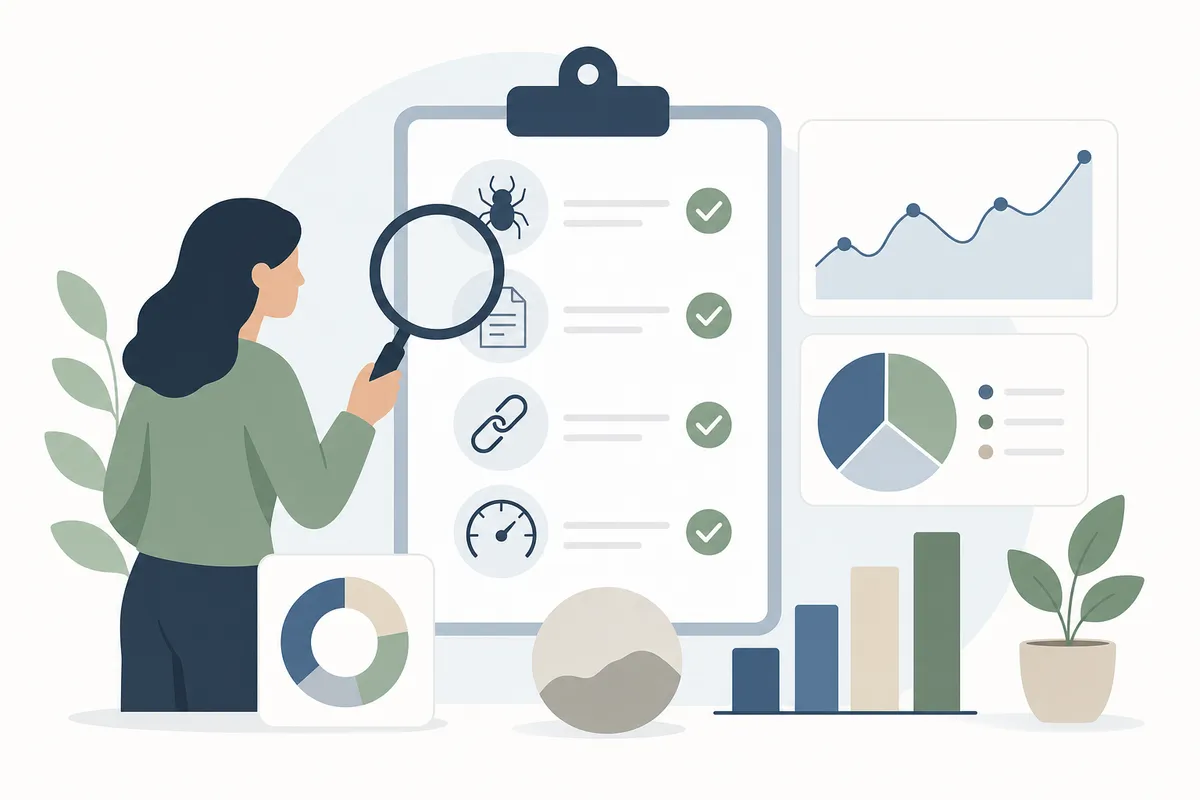
You cannot grow organic traffic on purpose if you do not know where it stands today, so start with an audit of technical health, current rankings and content performance. Skipping it is the most common reason SEO efforts stall. Teams begin writing before they know what is actually broken.
What to measure before you touch a keyword list
Pull three data sets first: crawl errors and indexation gaps, current keyword rankings with the pages behind them, and existing pages that get some traffic but underperform. The third group is often the fastest win, because those pages already carry some authority and only need a better brief.
Set goals you can actually check
Vague goals like "grow traffic" do not survive a quarterly review. Name a number and a window instead, such as a defined lift in organic sessions or a percentage improvement in conversion rate by the end of a quarter. Specific goals also make it obvious when a tactic is not working, so you can drop it early rather than six months in.
Step 2: Build a keyword research process you can repeat
Keyword research becomes a bottleneck the moment it depends on one person's intuition. A repeatable process pulls a wide seed list, filters it against volume and difficulty, groups the result by intent and hands a prioritized list to whoever writes the brief. Setting the criteria in advance, rather than judging each keyword on its own, is what makes the step delegable.

Filter before you prioritize
A junior team member can run this stage once the filters are set. Cut anything with negligible search volume, flag keywords whose difficulty is too high for your current authority, then cluster what remains by the intent behind the search. Our guide on identifying target keywords for your content strategy walks through that filtering logic in six steps, and it is worth building your brief template around it so every writer gets the same inputs.
Check what competitors already own
Before you commit a keyword to the calendar, check whether a competitor already ranks well for it and how thin or thick their coverage is. Running a keyword gap analysis against the sites already beating you surfaces terms nobody in your space has claimed. That is usually a faster path to page one than fighting for a keyword three competitors have already covered from every angle.
Step 3: Turn keywords into a content production pipeline
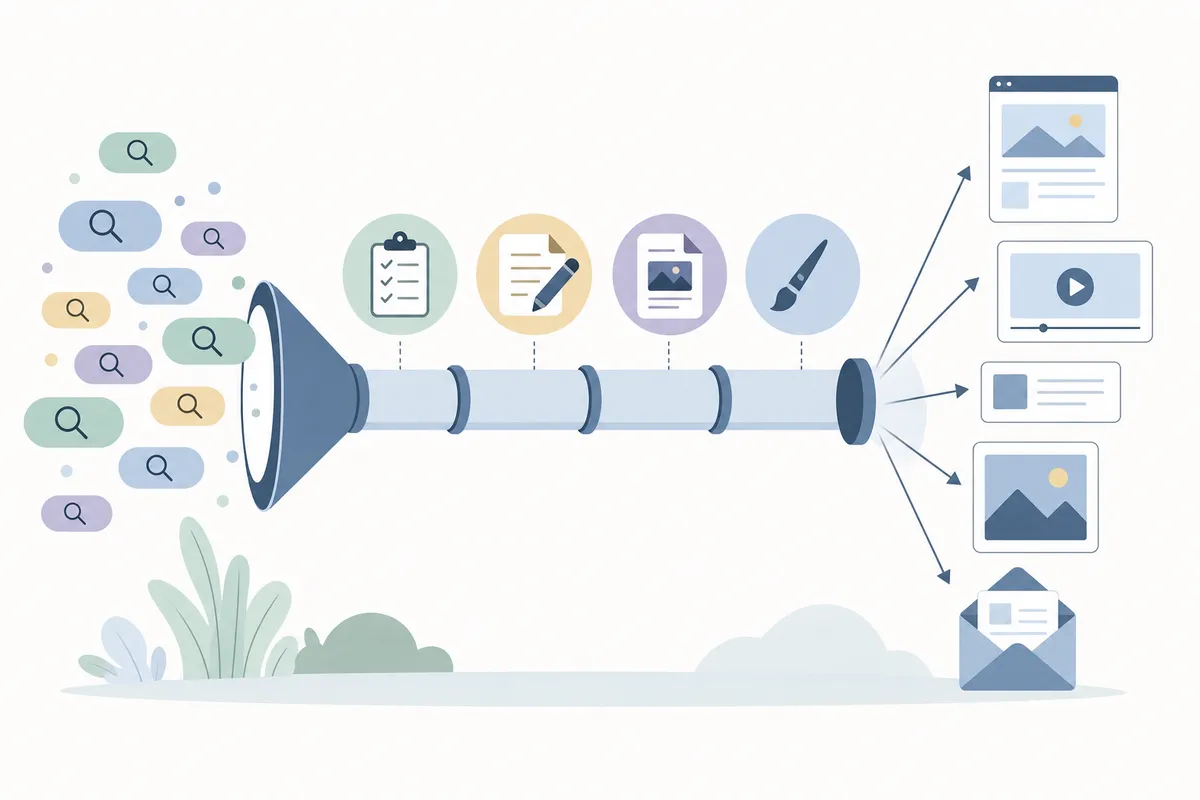
This is where most workflows fall apart. Writing gets treated as one undivided task instead of a sequence of smaller stages you can check, and giving each stage a rough time estimate makes throughput predictable and shows where a bottleneck is forming.
| Stage | What Happens | Typical Time |
|---|---|---|
| Brief creation | Target keyword, intent, competitor outline, and internal links are documented | 30 minutes |
| First draft | Writer produces the full piece from the brief | 3-4 hours |
| SEO optimization | Headings, keyword placement, and metadata are checked against the brief | 45 minutes |
| Editor review | A second person checks accuracy, tone, and structure | 30 minutes |
| Final approval | Client or manager sign-off before publishing | 15 minutes |
| Publication | Formatting, images, and scheduling in the CMS | 20 minutes |
Run end to end, the pipeline typically lands around 5-6 hours of total work per article once your team has it down. Knowing that number matters, because it lets you forecast how many pieces a team of a given size can ship in a month instead of guessing and missing deadlines.
Build quality checkpoints into the review stage
A checklist at the editor-review stage catches the mistakes that quietly tank a piece months later. Reasonable checkpoints include:
- A readability score above a set threshold
- The primary keyword in the title and at least one subheading
- Three to five internal links added per piece
- Images compressed to a reasonable file size
- A meta description that fits within the length search engines display
None of these take long on their own, but skipping them compounds across dozens of articles.
Good keyword research is wasted if the brief that comes out of it does not carry through to the draft. This walkthrough on doing keyword research that actually leads to rankings pairs well with the pipeline above and helps shape the brief before a writer opens a blank document.
Step 4: Strengthen internal linking and technical foundations
Published content only compounds if search engines can crawl it and readers can find related pages. Every new article should link to a few existing pages with varied, descriptive anchor text, and high-authority pages should occasionally link down to newer, related content. This is also where you catch overlap, when two articles quietly compete for the same query and dilute each other's ranking potential.

Run a periodic content gap analysis to see what topics your competitors rank for that you have not covered at this stage too. It doubles as a technical check, because gaps often reveal missing pages that would otherwise anchor a cluster of internal links. Google's own documentation backs this up: internal link structure is one of the main signals Google uses to understand which pages matter most and how they relate to each other, according to Google Search Essentials.
Step 5: Build authority with a structured outreach cadence
Backlinks still matter, but ad hoc outreach, one email here and one pitch there, rarely produces enough volume to move authority metrics. A structured four-week cadence turns link building into something a team member can own without reinventing the process each time.
| Week | Activity | Goal |
|---|---|---|
| Week 1 | Identify prospects | Around 50 relevant target sites |
| Week 2 | Research each prospect | Personalize the pitch angle |
| Week 3 | Send outreach | Deploy the initial email sequence |
| Week 4 | Follow up | Close out non-responders |
Run consistently, a cadence like this produces upward of 100 monthly outreach touches, so a handful of declines or ignored emails will not derail the month. The personalization research step is the one to document carefully. A templated email with the site name swapped in gets ignored, while a pitch that references something specific on the prospect's site gets replies.
Step 6: Turn the workflow into 90-day sprints
A workflow reviewed only once a year cannot adapt fast enough. It will miss algorithm updates, a competitor's new content push or a channel that stopped converting. Break the annual plan into 90-day sprints, give each its own goals and content calendar, and review at the end to decide what to keep, cut or double down on.
This is also the natural point to widen the workflow beyond content and links with technical priorities, resourcing and cross-team handoffs, especially once you manage many writers or multiple sites. Our 30-90-180 roadmap for scaling SEO operations lays out what should happen in each phase and covers the point where the workload outgrows a spreadsheet.
Document it so it survives turnover
Write down each stage of the workflow: its purpose, its owner, the tools involved and a short example of the finished output. Teams with a written process report getting new hires productive in around two weeks, compared with roughly two months when training relies on shadowing and verbal handoffs. That gap alone justifies the hour it takes to write the documentation.
FAQs
How long does it take to see results from an organic traffic growth workflow?
Most sites see early movement, such as new pages indexing and long-tail keywords appearing, within 60 to 90 days of consistent execution. Meaningful growth on competitive terms usually takes two to three sprint cycles, because search engines need time to trust a pattern of quality rather than a single batch of content.
Do I need a large team to run this workflow?
No. A single person can run every stage of a scaled-down version, provided the process is documented and the keyword and content stages are not skipped. The workflow matters more for consistency than for headcount, and a solo operator with a checklist will outperform a five-person team working without one.
What is the biggest mistake teams make when trying to scale SEO?
Publishing more content without fixing the process behind it. Doubling output on an undocumented, inconsistent workflow just doubles the number of weak pages competing against each other instead of compounding into real authority.
How often should I update the keyword and content plan?
Review it at the end of every 90-day sprint, at minimum. Update sooner if a major algorithm update or a competitor's content push changes what is realistically winnable. Locking a plan for a full year without revisiting it usually means chasing keywords that stopped mattering months earlier.
Can I run this workflow without expensive tools?
Yes, at a smaller scale. The framework itself does not require a specific tool, whether you are auditing, researching, producing, linking, doing outreach or reporting. What tools add is speed and consistency at volume: automating parts of keyword filtering, content briefs and reporting lets a small team run a workflow that would otherwise need several more hires.
Get a baseline before you build the workflow
Every stage above depends on knowing where your site stands right now, not where you assume it stands. Before you write a single brief, get a clear read on your current rankings, technical health and content gaps. You can see a sample SEO report to understand what that baseline should cover, then use it as the starting point for the organic traffic growth workflow for scalable SEO success you build from here.
Resources / References
Sources
- A Guide To Modern SEO Planning For Scalable Organic ...
- Scalable SEO Strategies for Independent Teams
- Top 6 Organic Traffic Solutions 2026
- AI in SEO: Practical SEO Automation, Tools, and Workflows ...
- What Are SEO Operations? Building Scalable SEO Systems
Disclaimer: This article is general information about rules and figures that applied when it was written, not personalised financial, tax or investment advice. It does not take account of your income, obligations, risk tolerance or goals, and rates and thresholds change. Verify the current position with the relevant authority, and speak to a licensed adviser or a qualified accountant before acting.
About the author
SearchBlueprint researched, wrote and scored this article with the content pipeline our customers run on their own sites. The score in the byline is what our content engine gave this page before it published. Nothing here is reviewed by hand, which is the point: it is the product's output, published where anyone can check it.