What Is an SEO Optimizer? Tool, Job, or Process Explained
SearchBlueprint · · 16 min read · scored 89/100
What is an SEO optimizer? It's either a software tool that analyzes and improves how a website performs in search results, or a person whose job is to do that work. The term also covers the optimization process itself. Which one you need depends on your site, your budget, and how much of the work you want to do yourself.
That triple meaning is exactly why the phrase confuses people. Search "what is an SEO optimizer" and you'll find software vendors, job descriptions, and even a Los Angeles agency literally named "SEO Optimizers", all answering a different version of the question. This guide untangles all three. It shows you what optimizer tools actually do under the hood, and gives you an honest read on when a free checker is enough and when it isn't.
What Is an SEO Optimizer? The Three Meanings
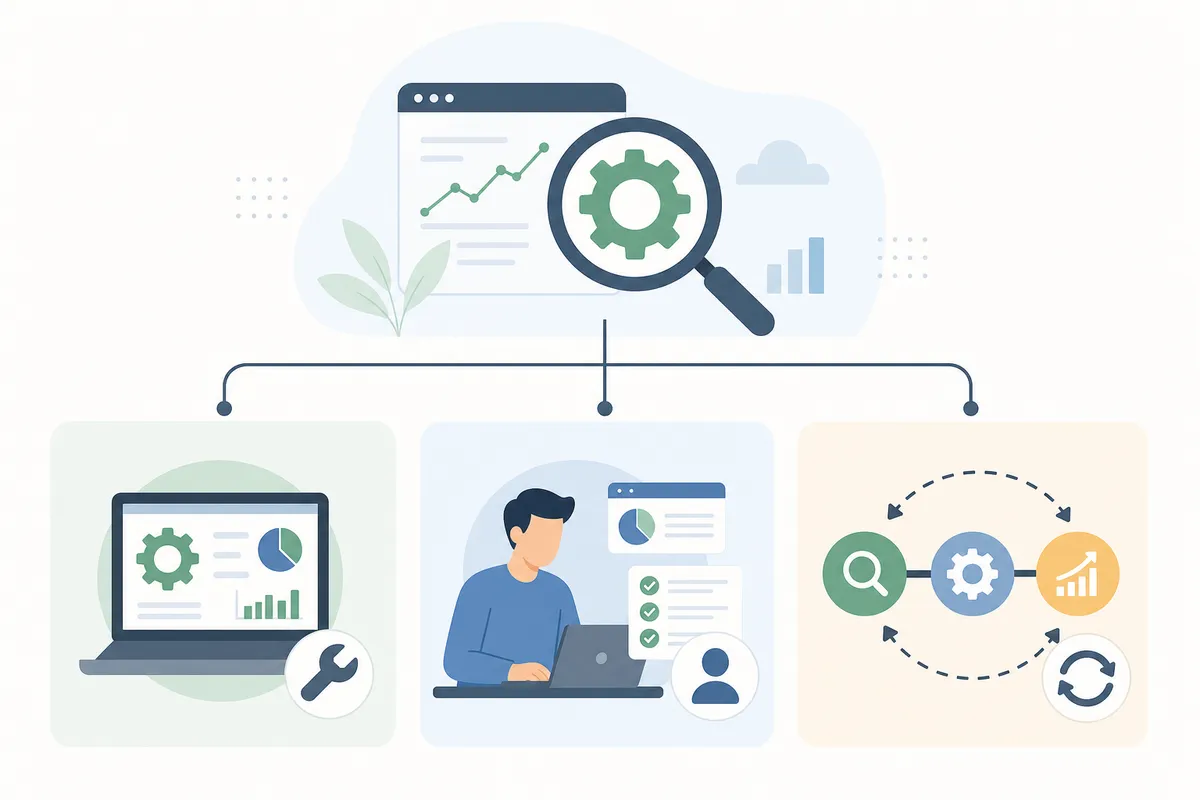
Before you can decide whether to buy one, hire one, or become one, you need to know which "one" you're dealing with. Here's how the three meanings break down.
| Meaning | What it is | How you pay for it | Best for |
|---|---|---|---|
| Optimizer tool (software) | An app that crawls pages, scores them against ranking factors, and recommends fixes | Free tiers to monthly subscriptions | Site owners and marketers doing SEO themselves |
| Optimizer role (person) | A specialist or consultant who runs keyword research, audits, content, and links | Salary, hourly rate, or monthly retainer | Businesses that want the work done for them |
| Optimization process | The ongoing practice of improving crawlability, content, and authority signals | Time, yours or someone you pay | Everyone; the other two exist to serve this |
The tool: software that finds and fixes ranking problems
When most people search this phrase today, they mean software. An SEO optimizer tool inspects a page or an entire site the way a search engine would. Then it flags what's holding it back: a missing title tag, a page that loads slowly, thin content, broken internal links, no structured data. Good ones go further and prioritize the fixes by likely impact, because a list of 400 undifferentiated errors helps nobody.
Optimizer tools range from single-purpose checkers, a meta tag validator, a rank checker, to full platforms that handle research, auditing, writing, and publishing in one system. We'll compare those models in detail below.
The role: a person who does the optimizing
An SEO optimizer (more commonly titled SEO specialist, SEO manager, or SEO consultant) is a professional who improves organic search performance as their job. Their work typically spans keyword strategy, on-page optimization, technical fixes, content planning, link earning, and reporting. Agencies package this role as a monthly service. In-house teams hire it as a full-time position.
The distinction matters when you're budgeting. A tool subscription is usually a fraction of what a retainer or salary costs, but a tool only tells you what to do. A person, or an automated platform, actually does it.
The process: what both exist to serve
Strip away the products and job titles. "SEO optimization" is simply the practice of making your site easier for search engines to crawl, understand, and trust, so more of the right people find it. That's the definition Google itself works from: SEO helps search engines understand your content and helps users find your site. Everything an optimizer tool or specialist does should ladder up to that. If a tool's recommendation doesn't help a crawler or a human, it's busywork.
If you're starting from zero, it helps to see the whole process before evaluating any product. Our guide to building an SEO strategy from scratch walks through it end to end.
How an SEO Optimizer Tool Actually Works

Under the hood, nearly every optimizer tool follows the same four-stage loop. Understanding it helps you judge whether a given product does the whole job or only part of it.
Stage 1: Crawl, see the site like a search engine does
The tool fetches your pages the way Googlebot does. It follows internal links, renders the HTML, and records what it finds: titles, headings, word counts, image alt text, load times, redirect chains, canonical tags. This mirrors how real search engines build their index. Crawlers follow links between and within sites, examine each page's content, and store it for retrieval. Google's own documentation at Google Search Central explains that the vast majority of pages in its results are discovered automatically this way. That's why crawlability problems are so damaging: if a crawler can't reach a page, no amount of great content saves it.
Stage 2: Analyze, score pages against known ranking factors
Next, the tool compares what it found against best practices: Is the title tag unique and descriptive? Does the page answer the query it targets? Is there duplicate content competing with itself? Is structured data present and valid against the vocabulary defined at Schema.org? Better tools also compare your page against the pages currently ranking for your target keyword, because "good" in SEO is relative. You don't need a perfect page. You need a better one than position #1.
Stage 3: Recommend, turn findings into a prioritized to-do list
This is where tools separate. A basic checker dumps every issue it found. A useful optimizer ranks them: fix the five pages blocked from indexing before you rewrite fifty meta descriptions. Want to see what a genuinely prioritized output looks like? Our 60-minute SEO audit walkthrough shows how to separate the fixes that move rankings from the ones that just move a score.
Stage 4: Track and verify, confirm the fix actually shipped and worked
The most overlooked stage. Rankings shift on their own schedule. Google notes that some changes take effect in hours while others take several months. So an optimizer that doesn't track positions over time can't tell you whether your work paid off. The newest generation of platforms adds a step older tools never had: publish verification, checking the live URL to confirm the recommended change actually made it onto the page. A recommendation that sits in a dashboard for six months optimized nothing.
The Four Core Functions of SEO Optimizer Tools
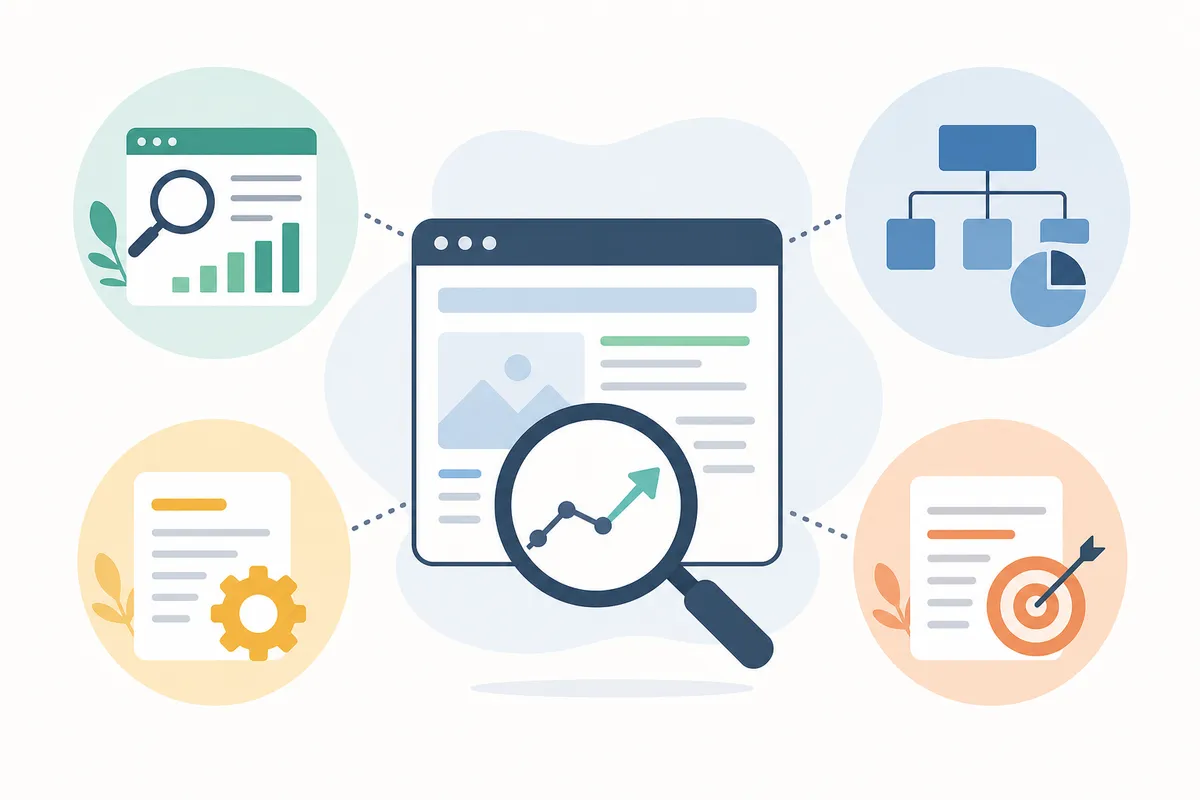
Whatever the branding, optimizer software earns its keep across four functions. Most standalone tools do one; platforms bundle all four.
| Function | What it does | Typical output | How often you use it |
|---|---|---|---|
| Keyword research | Finds the queries people actually type, with difficulty and intent signals | A prioritized keyword list mapped to pages | Monthly, plus before every new page |
| On-page optimization | Checks titles, headings, content depth, internal links, and meta tags per page | Page-level fix list and content score | Every time you publish or update |
| Technical auditing | Crawls the whole site for indexing, speed, duplicate content, and markup issues | Site-wide error report, prioritized | Monthly or after site changes |
| Rank tracking & reporting | Records positions for target keywords over time, per market | Trend charts and movement alerts | Weekly, automatically |
Keyword research: choosing battles you can win
Rankings are competitive, and specificity is your lever. It's far easier to rank for a precise long-tail phrase than a broad head term. The broad term has more searches, but also every big site in your industry fighting for it. A good optimizer surfaces the specific queries your audience uses and shows how hard each is. It then maps them to pages so two of your own URLs never chase the same term and cannibalize each other.
On-page optimization: the page-level fixes
On-page work covers everything within your control on the page itself: descriptive URLs, one clear H1, headings that structure the content, internal links, and copy that actually answers the searcher's question. It's one of three SEO pillars alongside off-page and technical work. If those categories blur together for you, our breakdown of on-page vs. off-page vs. technical SEO draws the lines clearly. At SearchBlueprint, this function is baked into content production itself. Our AI article writer runs 36 checks per draft before anything ships, so optimization happens at the point of writing rather than as a cleanup pass afterward.
Technical auditing: the invisible blockers
Technical issues are the silent killers because the page looks fine to you while being invisible or confusing to a crawler. Common finds: pages blocked by robots rules, duplicate content splitting authority across multiple URLs, redirect chains, slow rendering, and JavaScript that hides content from bots. Google's guidance is reassuring here: duplicate content isn't a spam violation, and search engines usually pick a canonical version on their own. But "usually fine" still wastes crawl resources and muddies which page ranks, so a good optimizer flags it anyway.
Some site types carry heavier technical loads than others. E-commerce stores, with thousands of product URLs, faceted navigation, and out-of-stock pages, are the classic case. That's why platforms build dedicated e-commerce SEO workflows for Shopify and BigCommerce rather than treating a 5,000-SKU store like a 30-page brochure site.
Rank tracking and reporting: proof the work is working
The final function closes the loop. Weekly position tracking per keyword and per market tells you whether the changes landed. But raw position data is only half the job; someone has to interpret it. If reporting is where your process breaks down, two resources help. Our SEO report template guide covers what a professional report should contain. And if you're on the receiving end of reports rather than writing them, there's a plain-language guide to reading an SEO report without technical skills.
The SEO Optimizer as a Job: What the Human Version Does
When "SEO optimizer" means a person, the day-to-day work looks like this: researching keywords and mapping them to pages, briefing or writing content, and fixing technical issues (or filing tickets for developers to fix them). Add earning links and mentions, monitoring rankings, and reporting results to whoever pays the bills.
What a human does that software can't
Software finds problems fast, but several parts of the job still require judgment:
- Strategy and prioritization. A tool can score every page; only a person can decide that this quarter, the money is in service pages rather than the blog.
- Business context. Software doesn't know your margins, your seasonality, or that half your leads come from one product line.
- Relationships. Digital PR, partnerships, and the kind of link earning that survives algorithm updates are human work.
- Editorial taste. Tools can check structure and coverage; deciding what's actually worth saying is still on you.
The honest framing is that the line keeps moving. Tasks that needed a specialist five years ago, drafting optimized articles, building internal links, generating location pages, are now reliably automated. Strategy and judgment aren't. Our guide on what SEO work to automate and what to keep human draws that boundary task by task.
What optimizers cost, honestly
Costs vary too widely by market and scope to pin a universal figure, but the ladder is consistent. Free checkers cost time. Tool subscriptions cost tens to hundreds per month. Platforms sit in the middle, bundling several tools' jobs. Human retainers or salaries cost multiples of any software option. For agencies, the human cost is the whole business model problem. That's why the highest-leverage question isn't "tool or person" but how to make each person cover more clients. There are proven ways to scale an SEO agency without hiring more staff, and most of them come down to letting platforms handle the four core functions above.
The Agency Named "SEO Optimizers"
Worth a clarifying note, because it muddies search results for this exact question: SEO Optimizers (plural) is also the name of a Los Angeles digital marketing agency, in business since 2007. Its site lists 19 years of search engine optimization experience, 17 years in paid advertising, 15 years in social media marketing, and 18 years in website analytics. It also lists a 4.9 rating based on 249 reviews. Reviewers report results like bookings increasing 200% within a couple of months. The agency states that most clients see map pack movement in four to eight weeks and competitive organic rankings in three to six months. If that's who you were searching for, that's a specific company, not the generic tool or role this article covers. But those timelines are useful data regardless of provider. They're a realistic picture of how long professional optimization takes to show results. Any provider promising dramatically faster should be treated with suspicion.
How SEO Optimizers Evolved: From Meta Tags to AI Answers
The tools exist because the game kept changing. A short history explains why today's optimizers look nothing like the first ones.
1997–2010: keywords, links, and the arms race
According to a 2004 article by industry analyst Danny Sullivan, the phrase "search engine optimization" came into use in 1997, with practitioner Bruce Clay credited as one of the first to popularize it. Early search algorithms weighted HTML attributes like meta tags heavily, which site owners quickly learned to manipulate. As early as 1997, search engines began adjusting algorithms to counter it. In 1998, Larry Page and Sergey Brin launched Google on PageRank, which rated pages by the quantity and strength of inbound links. That made pure on-page manipulation much harder. The first optimizer tools were born in this era: keyword density checkers and link builders, tuned to whatever the algorithm rewarded that year.
Google spent the following decade closing loopholes. It personalized results for logged-in users in 2005, campaigned against paid links that pass PageRank in 2007, and changed how nofollow links were treated in June 2009. In June 2010 it launched the Caffeine indexing system, which, per the Google engineer who announced it, delivered 50 percent fresher results than the previous index.
2011–2019: quality updates kill the shortcut tools
Then came the named updates that reshaped what optimizer tools had to measure. Panda (2011) targeted thin content. Penguin (2012) targeted link spam. Hummingbird (2013) brought natural language understanding, and BERT (2019) dramatically improved query comprehension. By 2015, Google was pushing mobile-first experiences as a core priority. Each update made keyword-stuffing tools obsolete and pushed optimizers toward what they measure today: content quality, user experience, and technical health. This is also the era when fragmented single-purpose tools multiplied: one for keywords, one for crawling, one for ranks, one for backlinks. That created the tool-juggling problem the industry is still unwinding.
2020s: optimizing for answers, not just rankings
The AI boom changed the target again. Marketers now optimize for LLM-based search under the labels answer engine optimization (AEO) and generative engine optimization (GEO). These are largely interchangeable terms for making your content the source that AI systems quote when generating answers. The tactics shift accordingly: clear self-contained passages, strong authority signals, and structured data, with the goal of being cited by AI rather than merely ranked by Google. If your traffic reports show growing referrals from ChatGPT or Perplexity, this is why. Two deeper reads help here. Our 2026 guide to answer engine optimization covers how to earn AI citations. Our analysis of what AI search engines mean for SEO strategy covers how to adapt your overall plan.
The practical upshot for anyone evaluating an SEO optimizer in 2026 is simple. If a tool only measures classic Google rankings and ignores AI answer visibility, it's measuring a shrinking share of where your customers actually search.
SEO Optimizer vs. Platform vs. Specialist: Which Do You Need?
Here's the decision most people searching this term are really trying to make. The honest answer depends on three things: how much time you have, how technical you are, and whether recommendations alone are enough, or you need the work executed.
| Option | What you get | The catch | Best fit |
|---|---|---|---|
| Free single-purpose tools | Point checks: meta tags, a rank lookup, keyword ideas | No prioritization, no execution, no history over time | Solo owners validating one page or one question |
| Standalone paid tools | Deep data in one function (keywords, crawling, or links) | You need 3–4 subscriptions to cover the whole job, and none of them does the work | Specialists who want raw data and do execution themselves |
| All-in-one SEO platform | Research, auditing, content production, publishing, and tracking connected in one loop | Less depth in any single function than the best specialist tool | Businesses and agencies that need findings turned into shipped pages |
| Human specialist / agency | Strategy, judgment, and done-for-you execution | The most expensive option; quality varies enormously by provider | Companies with budget who want SEO fully off their plate |
The real cost of the fragmented toolkit
The trap most teams fall into is the second row: assembling a stack of standalone tools that each does one function. The subscription costs add up, but the bigger cost is friction. Your keyword tool doesn't talk to your crawler. Your crawler's findings sit in a CSV. Your rank tracker shows movement but can't tell you which fix caused it. Every hand-off between tools is a place where the work stalls. A recommendation that never becomes a live page change has zero SEO value, no matter how accurate it was.
That gap between knowing and shipping is the single biggest reason sites with expensive tool stacks still don't grow. It's also why the market moved toward platforms that close the loop: find the issue, produce the fix, publish it, verify it's live, and track the result, one system, one workflow. It's the model we run on our own site. Our dogfooding case study documents a 347% organic traffic increase from applying the platform's own recommendations to searchblueprint.io.
When Free Tools Are Genuinely Enough
Fairness demands the flip side: not everyone needs a platform or a specialist. If you run a five-page local site, a free on-page checker, Google's own Search Console, and a few hours a month will cover most of what matters. Free tools break down at scale, dozens of pages, multiple markets, weekly content, not at the small end. Before spending anything, read our honest breakdown of free vs. paid SEO tools and what you actually need to buy. The answer for many small sites is "less than the vendors say."
How to Evaluate an SEO Optimizer Before You Commit
Whether you're comparing software or interviewing a consultant, the same filters apply: ask for prioritized recommendations rather than raw error dumps, proof that fixes get executed and verified rather than left in a dashboard, transparent tracking over time, and realistic timelines rather than ranking guarantees. Anything that fails those filters will cost you money without moving your rankings.
FAQs
Is an SEO optimizer a tool or a person?
Both, legitimately. "SEO optimizer" can mean software that audits and improves a site's search performance, or a specialist (usually titled SEO specialist, manager, or consultant) who does that work as a job. Context tells you which one someone means, and the term also covers the optimization process itself.
What does an SEO optimizer tool actually do?
It performs four core functions: keyword research, on-page analysis, technical auditing, and rank tracking. Under the hood, most tools follow the same loop: crawl your pages like a search engine, score them against ranking factors, recommend prioritized fixes, and track whether positions improve over time.
Are free SEO optimizer tools good enough?
For small sites, often yes. A five-page local site can get by with a free on-page checker, Google Search Console, and a few hours a month. Free tools break down at scale, dozens of pages, multiple markets, or weekly content, where the lack of prioritization, execution, and history over time becomes costly.
How much does an SEO optimizer cost?
The ladder is consistent even though exact figures vary by market: free checkers cost time, standalone tool subscriptions run tens to hundreds per month, all-in-one platforms sit in the middle by bundling several tools' jobs, and human retainers or salaries cost multiples of any software option.
Can an SEO optimizer guarantee first-page rankings?
No. No optimizer, human or software, can guarantee rankings. Google states plainly in its own documentation that there are no secrets that automatically rank a site first. Any provider promising guaranteed positions or dramatically fast results should be treated with suspicion.
How long does it take for SEO optimization to show results?
Google notes that some changes take effect in hours while others take several months. Realistic professional timelines run around four to eight weeks for local map pack movement and three to six months for competitive organic rankings, which is why tracking positions over time matters.
The Bottom Line
So, what is an SEO optimizer? It's the tool that finds the problems, the person who fixes them, or the process both serve, and the right answer for you depends on your site's size, your budget, and whether you need recommendations or executed work. If you want to see what the output of a closed-loop optimizer actually looks like before committing to anything, browse a sample SEO report and judge for yourself whether the findings, fixes, and tracking are the kind you could act on.
Resources / References
Sources
- Search Engine Optimization (SEO) Starter Guide
- Search engine optimization
- What is SEO? (Search Engine Optimization)
- SEO Optimizers: Los Angeles SEO Agency & Digital Marketing
- What Is SEO - Search Engine Optimization?
Disclaimer: This article is general information about rules and figures that applied when it was written, not personalised financial, tax or investment advice. It does not take account of your income, obligations, risk tolerance or goals, and rates and thresholds change. Verify the current position with the relevant authority, and speak to a licensed adviser or a qualified accountant before acting.
About the author
SearchBlueprint researched, wrote and scored this article with the content pipeline our customers run on their own sites. The score in the byline is what our content engine gave this page before it published. Nothing here is reviewed by hand, which is the point: it is the product's output, published where anyone can check it.