What Is AI-Generated Content and Its SEO Impact: What Google Rewards
SearchBlueprint · · 10 min read · scored 95/100
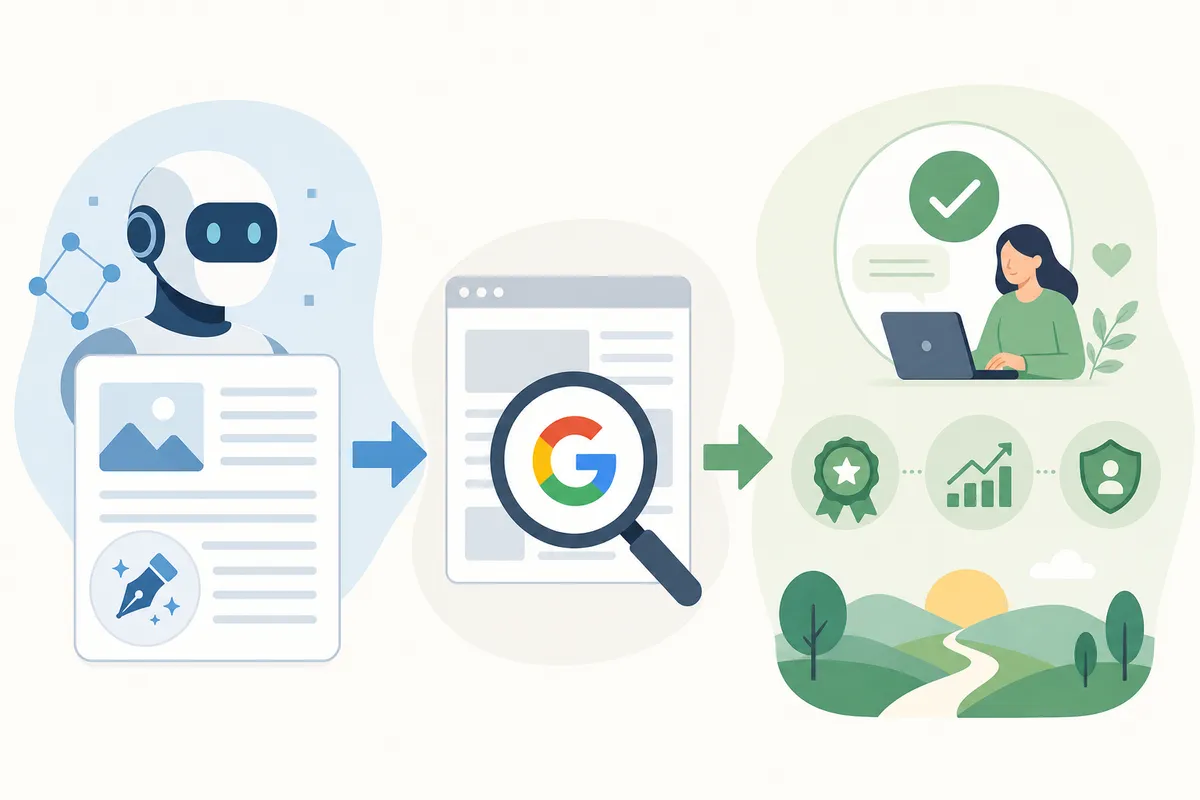
What is AI-generated content and its SEO impact? AI-generated content is text, imagery, audio, or video that a machine learning model produces from a prompt. Its SEO impact depends on quality, not origin: Google rewards helpful, original work that demonstrates experience and expertise however it was made, and treats content generated mainly to manipulate rankings as spam.
That is the policy. Results in the wild are messier. When HubSpot surveyed more than 300 web strategists, 46% said AI has helped their pages rank higher, 36% felt it made no difference, and 10% had seen rankings drop. This guide is for marketers and site owners who want to know which of those groups they will land in, and why.
What is AI-generated content?
AI-generated content is any material a generative model creates in response to a prompt: blog posts, product descriptions, meta titles, images, video scripts, even code and structured data. You describe what you want, and the model drafts it in seconds instead of hours.
How the tools actually produce it
Large language models are trained on enormous volumes of text. From that training they learn which words are likely to follow which, so a prompt like "explain mortgage refinancing for first-time buyers" returns a fluent, structured draft almost instantly. The model is not copying an existing article. It generates new sentences from learned patterns, which explains both its strength and its weakness. The strength is speed and fluency. The weakness is that patterns carry no lived experience and no guarantee of truth, so a confident draft can still be wrong.
The main types you will meet
- Long-form articles and guides, the most common SEO use
- Product and category descriptions, often generated at scale for e-commerce catalogs
- Titles, meta descriptions, and headline variants for testing
- Images, video, and audio built from text prompts
- Outlines, briefs, FAQ answers, and structured data drafts
One misconception worth clearing up early: AI-generated content is not automatically spam, and no major search engine bans it. What matters is what you publish, not what drafted it.

Google's rules: quality over origin
Google settled the policy question in a February 2023 statement on the Google Search Central Blog: its ranking systems reward original, high-quality content that demonstrates E-E-A-T (experience, expertise, authoritativeness, and trustworthiness), regardless of how it is produced. Google points out that automation has generated useful content for years, naming sports scores, weather forecasts, and transcripts as examples.
What the spam policy actually bans
The same guidance draws one hard line. Using automation, including AI, to generate content with the primary purpose of manipulating search rankings violates Google's spam policies, and systems like SpamBrain look for that pattern however the spam was produced. The spam policies in Google Search Essentials also cover scaled content abuse: churning out many low-value pages faster than anyone could vet them. A thousand thin pages are a spam problem whether a model wrote them or an intern did.
Bylines and disclosure
Google recommends against naming AI as an author. Bylines belong on content where readers would ask who wrote this, and publishers in Google News are required to use them. An AI disclosure is appropriate wherever a reader might reasonably ask how the content was created. Neither is a ranking lever. Both are trust signals for the people you want returning.

The SEO impact of AI content, in numbers
Policy says quality decides. So what happens when real teams publish AI-assisted pages? The measured answers come in three parts.
Rankings: three camps
HubSpot's survey of 300+ web strategists split cleanly. 46% said AI helped their pages rank higher. 36% said it made no difference. 10% saw rankings fall. On broader content performance, the same research found 34% saying AI boosts it, 19% seeing no change, and 6% saying it hurts, while 29% believe AI does not improve ROI but does speed up content creation. Speed is the dependable benefit. Ranking gains are earned in the edit.
| Reported outcome | Share of respondents | How to read it |
|---|---|---|
| AI helped pages rank higher | 46% | The largest camp in HubSpot's survey of 300+ strategists; these teams edit drafts to E-E-A-T standards rather than publishing raw output |
| AI made no difference to rankings | 36% | The same survey's middle group; lightly edited drafts tend to blend into the results rather than beat them |
| Rankings dropped after adopting AI | 10% | The loss camp in HubSpot's data; unedited, high-volume publishing is the pattern spam systems target |
| AI improves overall content performance | 34% | A separate HubSpot finding covering engagement and traffic, not rankings alone |
| AI speeds production without lifting ROI | 29% | HubSpot's honest middle: faster output, same results, until quality rises |
116 articles in 30 days
The case study both skeptics and enthusiasts cite comes from SEOwind, which reported publishing 116 AI-generated articles in 30 days and seeing a 77% increase in clicks and a 124% boost in impressions. Two caveats matter. The study ran in 2023, and nobody has published how those pages perform today. And the team did far more than generate: keyword research and gap analysis, human-guided outlines, added quotes and figures, internal and external links, descriptive alt text on images, and sentence-level editing. That is an AI-assisted editorial operation, not a content vending machine. For a current view of which AI-assisted pages hold their positions, see this breakdown of AI-generated articles that actually rank in 2026.
Headlines: the clearest AI win
Danish broadcaster TV 2 Fyn used ChatGPT to write headline variants and ran 46 A/B tests over three weeks in late 2022 and early 2023. AI-generated headlines won 46% of the tests; human-written headlines won 24%. The winning AI headlines drove a 59% increase in click-through rate. Even here, editors refined the model's suggestions before publishing. Narrow, testable tasks with fast feedback are where the technology shows its cleanest results.

Where AI drafts fall short
Every failure mode below has hurt real sites. None is hard to prevent once you treat a draft as raw material rather than finished work.
| Risk | What goes wrong | How to prevent it |
|---|---|---|
| Hallucinated facts | Models invent statistics, studies, and quotes that read as real | Verify every number, name, and citation against a primary source before publishing |
| Missing experience | Drafts contain no first-hand testing, client work, or original observation, the first E in E-E-A-T | Add the author's own examples, data, and judgment during the edit |
| Sameness | Competitors prompting the same tools on the same topics receive similar articles | Include proprietary detail a model cannot generate: your numbers, your cases, your stance |
| Stale information | Models write from training data that lags the present, so dates, prices, and product facts drift wrong | Check anything time-sensitive against a current source |
| Scaled publishing | Output outruns editorial capacity and the site fills with thin pages | Publish at the pace your editing supports, not the pace generation allows |
The experience gap deserves emphasis because it is invisible in a fluent draft. A model can describe what mortgage refinancing is. It cannot tell the reader what surprised your last ten clients about it. A page that adds nothing a reader could not get from any other AI-drafted page has no reason to outrank them. Each of these traps has a practical fix, and they are covered step by step in this guide to using AI content writers without tanking your rankings.

Formats where AI wins and loses
HubSpot's research also asked which content types will thrive as AI adoption grows, and the split maps neatly onto the experience gap.
| Content type | Expected outlook | Share of HubSpot respondents | Why |
|---|---|---|---|
| Educational guides and how-tos | Best performers | 45% | Structured, factual formats play to what models draft well |
| Review and comparison content | Likely winners | 37% | Clear criteria suit AI-assisted drafting, provided a human verifies the claims |
| Personal stories | Biggest challenges | 30% | The format is lived experience, which a model does not have |
| Opinion pieces | Likely to struggle | 28% | A defensible point of view needs an author who can defend it |
Read the table as a division of labor, not a verdict. The model drafts the explainer. You supply the story and the stance.
How to use AI-generated content without losing rankings
The teams in the 46% run a repeatable process rather than a prompt-and-publish loop. It looks like this:
- Start AI on research, not prose. Generate keyword ideas, background summaries, and outlines first. These are low-risk tasks where speed compounds and errors are easy to catch.
- Prompt with your specifics. Feed the model your audience, product facts, and data. Generic prompts produce the same article your competitors are generating.
- Edit like a fact-checker. Verify every statistic, name, and claim. Assume the draft is wrong until proven right.
- Add what a model cannot. First-hand examples, customer quotes, original data, links to your own related pages, and images with descriptive alt text.
- Match volume to editing capacity. Publishing 116 articles in 30 days worked for a team doing full editorial passes on each one. Without that capacity, the same volume reads as scaled content abuse.
- Decide per task, not per policy. Some pages deserve a human from the first word. This comparison of AI and human writers, and when to use each maps the split by page type.
Nothing here is exotic. It is the editorial discipline publishers have always applied, pointed at a much faster first draft.
FAQs
Does Google penalize AI-generated content?
No. Google's published guidance says its systems reward high-quality content no matter how it is produced. What gets penalized is spam: content generated primarily to manipulate rankings, at any scale, by any method.
Can AI-generated content rank on page one?
Yes, and it demonstrably has. In HubSpot's survey, 46% of strategists said AI helped their pages rank higher. The pages that win share heavy human involvement in research, editing, and fact-checking. Raw output is far more likely to join the 36% who see no difference.
Do you have to disclose that content is AI-generated?
There is no blanket requirement for ordinary marketing content. Google suggests disclosure where readers would reasonably ask how the content was made, and it recommends against listing AI as the author. Human bylines are expected where readers expect them, and required for Google News publishers.
Do AI detection tools affect SEO?
Not in any way Google has described. Its guidance points to quality-based systems, spam detection included, rather than detector scores, and detector verdicts vary widely between tools. Time spent beating a detector is better spent making the page accurate and useful.
How much editing does AI content need before publishing?
More than most teams budget for. In the SEOwind case study, the drafts were backed by keyword research, human outlines, added quotes and figures, internal and external links, alt text, and line editing. Plan a full editorial pass on every draft, with fact-checking as the step you never skip.
Put one of your pages to the test
Take the last AI-assisted page you published and audit it before you ship the next batch; your own data will tell you more about what is AI-generated content and its SEO impact for your site than any survey can. When you want a second pair of eyes, talk to the team and walk through a sample SEO report to see exactly what a full audit would flag on your site.
Resources / References
Related reading: How AI content for Google Discover gets picked in 2026.
Sources
- Google Search's guidance about AI-generated content
- Does AI content negatively impact SEO? : r/DigitalMarketing
- Is AI-Generated Content Good for SEO?
- AI-Generated Content: Benefits, Risks & SEO Best Practices
- Does AI Content Work for SEO? Pros, Cons, & Uses
Disclaimer: This article is general legal information, not legal advice, and does not create a solicitor-client relationship. The law changes and its application depends on your particular facts. Speak to a qualified lawyer in the relevant jurisdiction before acting — some rights and claims are subject to strict time limits.
About the author
SearchBlueprint researched, wrote and scored this article with the content pipeline our customers run on their own sites. The score in the byline is what our content engine gave this page before it published. Nothing here is reviewed by hand, which is the point: it is the product's output, published where anyone can check it.