The Local SEO Definition, Explained (and Why It Matters)
SearchBlueprint · · 12 min read · scored 89/100

Local SEO means optimizing your online presence to appear in unpaid, location-based search results, the Google map pack, Google Maps, and localized organic listings, when nearby customers search for what you sell. Any business that serves a specific area needs it, from dentists and plumbers to bakeries and law firms.
That one-sentence answer hides a lot of moving parts, though. Local search runs on different signals than regular search. The businesses that understand those signals consistently outrank the ones that don't. This guide unpacks the definition properly: where local SEO came from, how Google ranks local results, the core elements to work on, and how to measure whether it pays off.
Key Takeaways
- Local SEO targets unpaid visibility in geographically filtered results, the map pack, Google Maps, and localized organic listings, not paid ads.
- Google ranks local results on three main criteria: relevance, distance, and prominence. Regular organic rankings use different systems.
- The core elements are your Google Business Profile, consistent NAP citations, reviews, localized on-page content, and local links.
- A 2016 statistical study of Local Pack rankings found backlinks and reviews correlated most strongly with high positions; citations were "foundational but not a competitive advantage."
- You can measure local visibility properly only with a rank grid, because your position changes street by street.
The Local SEO Definition in Plain English
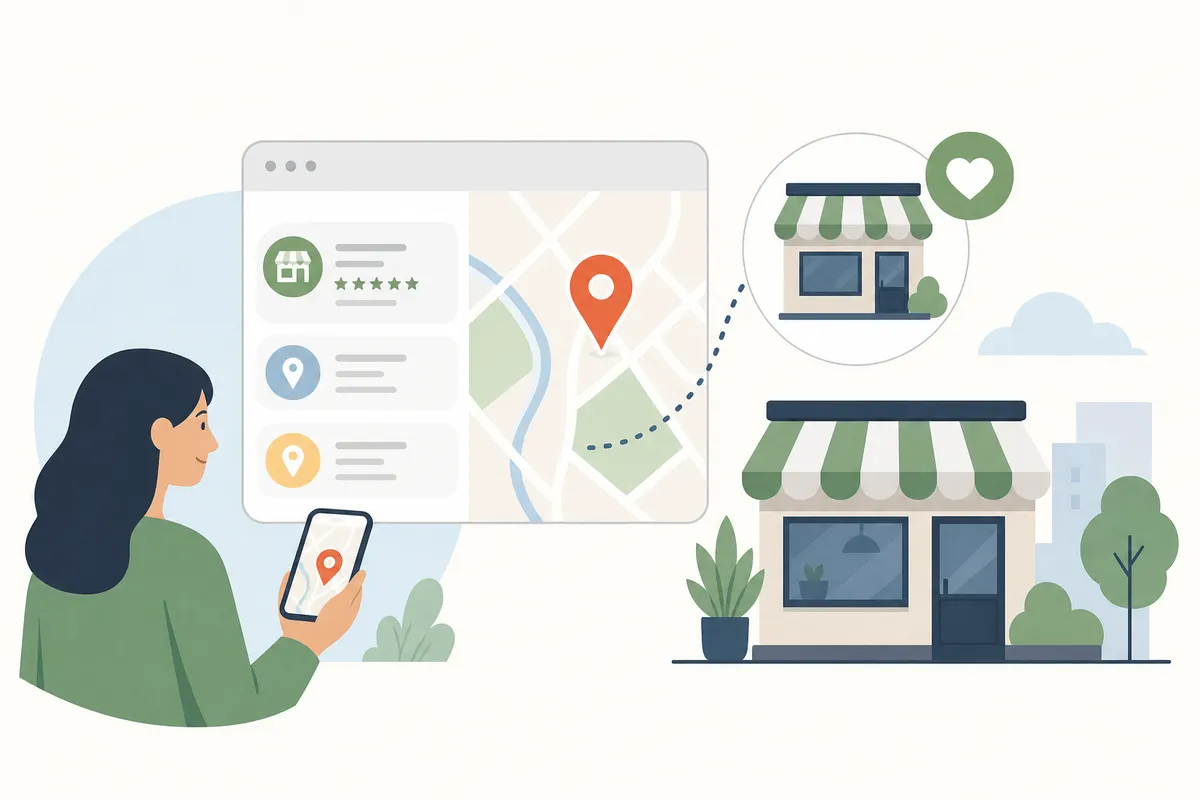
Local SEO (local search engine optimization) is the process of increasing a business's visibility in search results that are filtered by location. When someone searches "emergency plumber near me" or "coffee shop downtown," search engines don't return the best pages on the internet. They return the best options near that searcher. Local SEO is everything you do to be one of those options.
Two things separate it from general SEO. First, the surface: local searches trigger a distinct result type, the Local Pack (the map with three business listings), alongside the standard organic links. Second, the algorithm: Google uses partially different systems to rank localized results. It weights your physical location, your Google Business Profile, and mentions of your name, address, and phone number across the web.
Local SEO vs. Traditional SEO: What's Different
| Factor | Local SEO | Traditional SEO | Why it matters |
|---|---|---|---|
| Goal | Rank in the map pack and localized organic results for a city or service area | Rank in organic results regardless of the searcher's location | Different goals mean different tactics, you can't blog your way into the map pack |
| Primary asset | Google Business Profile plus your website | Your website alone | An unclaimed or thin Business Profile caps local visibility no matter how good the site is |
| Key off-site signal | NAP citations, reviews, and local links | Backlinks and brand mentions at large | A review on Google can move local rankings; it does little for a national keyword |
| Ranking criteria | Relevance, distance, prominence | Relevance, content quality, usability | Distance is a factor you can't optimize directly, you offset it with prominence |
| Result location | Map pack, Google Maps, localized SERPs | Standard "blue link" results | Businesses can appear in both simultaneously, doubling visibility for one search |
Where Local Results Actually Appear
A local search typically produces two result types on the same page:
- The Local Pack: three business listings under a map, drawn from Google Business Profile data, hours, reviews, photos, categories. It sits at or near the top of most local searches. That makes it the highest-value real estate in local search.
- Local organic results: standard web listings with local relevance. These often include directories like Yelp alongside individual business websites, ranked by Google's regular organic systems.
Because separate algorithms control the two, a business can hold a map pack spot and an organic position for the same query. That dual visibility is the practical payoff of doing local SEO well.
Where Local SEO Came From
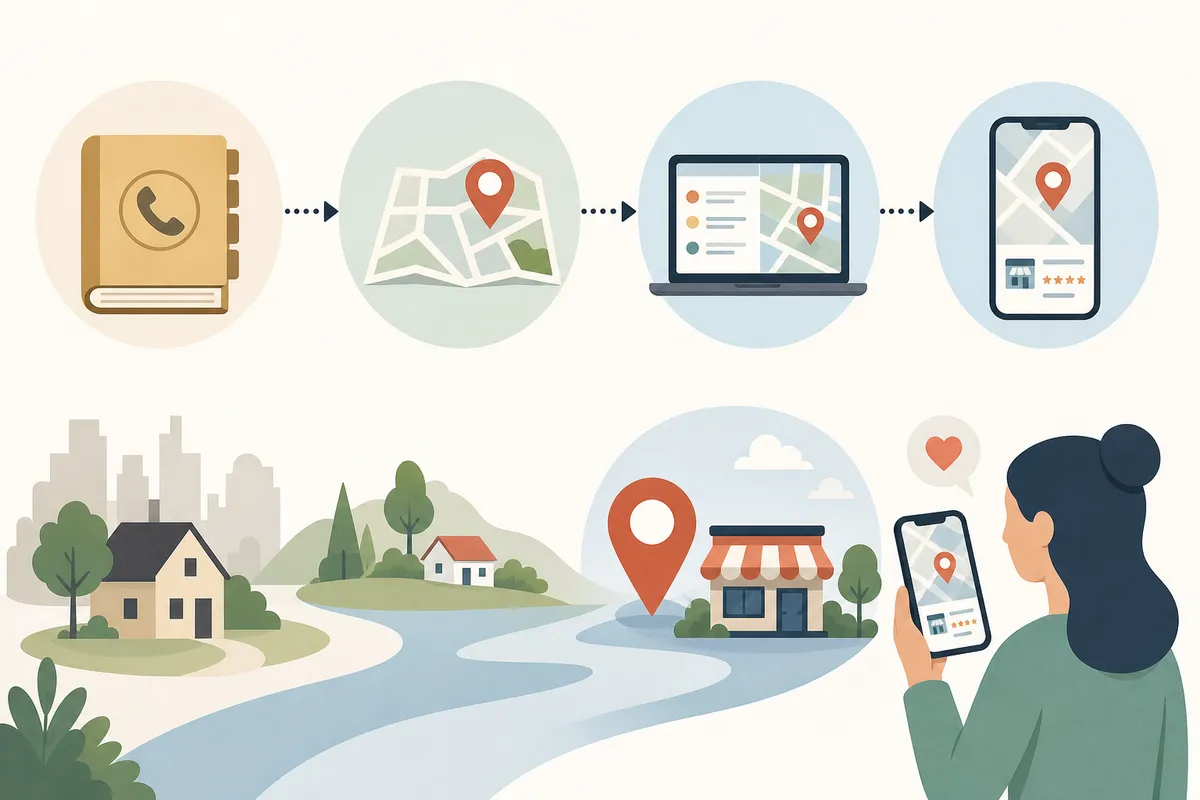
Local SEO is not new. Its origin is generally traced back to 2003–2005. That's when search engines first tried to give people results in their vicinity, along with extra details like store opening hours and map listings. What began as a convenience feature evolved into a distinct discipline with its own ranking signals. Broader organic SEO, by contrast, prioritizes content relevance over distance from the searcher.
Two algorithm updates shaped modern local search more than any others:
- Possum (September 1, 2016): Businesses located just outside city limits saw significant ranking gains, and Google introduced a stricter filter. After Possum, listings sharing the same address and categories got filtered even if they belonged to different businesses. If several dentists share one building, Google may show only one.
- Hawk (August 22, 2017): A correction to Possum's over-filtering. Reports at the time said the filter still applied to listings in the same building or very close by (around 50 feet). It no longer suppressed businesses a few hundred feet apart.
The rise of "near me" queries accelerated everything. Once both Google and Apple offered "near me" as a native search option, Google Trends showed very significant increases in these queries. The commercial stakes of local visibility rose with them. Mobile searchers looking for something "near me" usually need it soon. That is exactly the intent local SEO captures.
How Google Ranks Local Results
Understanding the ranking criteria is the difference between guessing and strategy. Google states that local results are ranked primarily on three criteria. Its broader documentation of ranking systems is published at Google Search Central.
Relevance, Distance, and Prominence
- Relevance: how well your listing matches what the user searched. Complete, accurate business categories and detailed profile information help Google make the match.
- Distance: how far your business is from the searcher or the location named in the query. If no location term is used, Google says it "will calculate distance based on what's known about their location."
- Prominence: how well-known your business is, both offline and online. Google draws on review counts, links, and articles about your business to assess it. A landmark store gets more prominence than an unknown one, but online signals can close the gap.
Distance is largely out of your control. Relevance and prominence are not. That's why almost every local SEO tactic maps back to one of those two.
What Independent Research Found
Because Google doesn't publish algorithm weights, practitioners have tried to reverse-engineer them. In 2016, a study used statistical analysis to assess how and why businesses ranked in Local Packs. It found positive correlations between rankings and more than 100 factors. Its most useful findings:
- Backlinks showed the strongest correlation with high local rankings.
- Reviews on the business's Google listing strongly correlated with top positions; photos and verified profiles with posted hours helped too, though less.
- Citation quality mattered for appearing in the pack, low duplicates, consistency, a fair count. Within the pack, though, citations didn't drive position. The authors' phrasing: citations appear to be "foundational but not a competitive advantage."
- A keyword in the business name was one of the most important factors. That also explains the persistent spam problem of keyword-stuffed business names in the Local Pack.
- Surprisingly, city and state in the title of the Business Profile's landing page showed no measurable impact. The authors suggested adding geo terms only where it helps usability.
A 2017 survey of 40 local SEO experts pointed the same direction: links and reviews are more important than ever for ranking locally. Nearly a decade later, that consensus still holds up in practice.
The Core Elements of Local SEO
A working definition only becomes useful when you know what to actually do. These five elements cover most of the local ranking influence.
| Element | What it is | Main signal it feeds | First action |
|---|---|---|---|
| Google Business Profile | Your free business listing on Google Search and Maps | Relevance + prominence | Claim, verify, and complete every field including categories and hours |
| NAP citations | Mentions of your name, address, and phone number on directories and other sites | Trust in your business data | Audit top directories and fix every mismatch |
| Reviews | Ratings and written feedback on Google and other platforms | Prominence | Ask every satisfied customer; respond to all reviews |
| Localized on-page SEO | Location keywords, location pages, LocalBusiness schema on your site | Relevance | Build one genuinely unique page per location or service area |
| Local links | Backlinks from local news, sponsorships, and community organizations | Prominence | Sponsor one local event or join the chamber of commerce |
Google Business Profile
Your Business Profile is the engine of map pack visibility. Listings must represent a real location or service area, and accuracy is itself a local ranking factor. Complete every section: primary and secondary categories, services, hours, photos, and attributes. Then keep it active, updated holiday hours, posts about offers, answered questions. An abandoned profile signals an abandoned business.
Citations and NAP Consistency
Citations are online mentions of your name, address, and phone number, on directories like Yelp, on data aggregators, and on other relevant sites like a chamber of commerce website. Google uses them to verify your business data is trustworthy. The standard guidance from practitioners: keep all your citations 100% consistent, the exact same name, address, and phone number everywhere. "Joe's Pizza" on one directory and "Joe's Pizzeria" on another creates doubt about which record is correct. Doubt suppresses rankings. Prioritize the major platforms, Apple Maps, Yelp, Bing Places, Facebook, plus directories specific to your industry and area.
Reviews
Reviews feed prominence directly and conversion indirectly. A 4.8-star business with 200 reviews wins clicks from a 4.1-star business with 12, even at the same rank. Ask consistently (QR codes on receipts and counters work well). Never pay for reviews, it violates Google's terms, and in the U.S. the FTC's rule on fake reviews makes buying them illegal. Respond to everything, including the bad ones. Fake reviews remain a real problem in local search. The honest, boring path of steadily earned reviews is also the durable one.
Localized On-Page SEO and Technical Health
Your website supplies the relevance signals: local keywords in titles, headings, and meta descriptions; a location page for each area you serve with genuinely unique content; NAP in the footer matching your citations; and LocalBusiness structured data, which lets you present hours, address, and other details in a machine-readable format defined at Schema.org. None of it works on a site Google struggles to crawl. It's worth running a technical SEO audit that puts the fixes in priority order before layering local content on top. If your site runs on WordPress, the WordPress-specific SEO workflow covers the platform quirks. There are equivalent playbooks for other platforms your site might live on.
Local Links
The 2016 study put backlinks at the top of the correlation list. Local links are the variety you can realistically earn: coverage in regional news, event sponsorships, partnerships with nearby businesses, and listings with community organizations. One link from a respected local publication typically does more for prominence than a dozen generic directory entries.
Who Needs Local SEO, and Who Doesn't
Local SEO fits any business whose customers are geographically constrained. That covers two groups:
- Physical-location businesses: restaurants, dental clinics, salons, retail shops, gyms, anywhere customers walk in.
- Service-area businesses: plumbers, electricians, landscapers, tutors, mobile mechanics, businesses that travel to the customer.
It also fits multi-location brands, which need a distinct Business Profile and a distinct location page per branch, genuinely local pages, not one template with the city name swapped.
Who doesn't need it: businesses with no geographic constraint at all. A purely online store shipping nationwide gains little from map pack optimization. Its growth levers are product-page rankings and category structure, a different discipline built for Shopify and BigCommerce stores. Plenty of businesses are hybrids, though. A bakery that ships gift boxes nationally still needs local SEO to fill the counter queue.
Can You Do Local SEO Yourself?
Honestly: yes, much of it. The foundational work requires consistency more than expertise. Claiming and completing your Business Profile, standardizing your NAP across directories, asking for reviews, and adding your service area to page titles are all free and doable in evenings. For a single-location business in a low-competition market, that foundation alone often earns map pack visibility.
Where DIY runs out of road:
- Competitive markets. When every dentist in town has a complete profile and 100+ reviews, rankings come down to links, content depth, and technical detail, the areas that reward experience.
- Multiple locations. Ten locations means ten profiles, ten location pages, and ten review streams. The workload scales linearly; your evenings don't.
- Diagnosis. Knowing you rank #7 is easy. Knowing why, a citation mismatch, a category error, thin location pages, weak links, takes tooling and pattern recognition.
The middle path many owners take: handle the profile and reviews yourself, and use software to automate the analysis and content work. An AI SEO agent that runs the whole audit-to-publish loop from a single URL can compress most of the diagnostic and drafting effort that would otherwise justify an agency retainer.
Measuring Local SEO Success
Here's the trap that catches most business owners: checking your own ranking from your own office. Because distance is a core ranking criterion, your position for "plumber near me" is different at your desk than it is three miles across town. A single rank number is close to meaningless in local search.
Use a Rank Grid, Not a Single Rank
A local rank grid checks your position from a matrix of points across your service area, say a 7×7 grid over your city. It shows where you win the map pack and where you disappear. That's the honest picture: strong at the center, invisible at the edges is the typical starting shape. You can run one free with a local search grid that maps your map-pack visibility point by point, then track how the green zone expands as your citations, reviews, and location pages improve. For ongoing programs, rank grids paired with generated location pages close the loop between measurement and the fix.
The Metrics That Actually Matter
Beyond grid position, track the numbers that connect visibility to revenue:
- Business Profile actions, calls, direction requests, and website clicks from your profile insights.
- Local organic traffic, sessions from your city and service areas in your analytics.
- Conversions, form fills, bookings, and calls attributable to local search.
- Review velocity and rating, count and average score over time, versus your top three competitors.
If you report to a boss, partner, or client, package these consistently. This guide to what belongs in a professional SEO report covers the structure that keeps local metrics readable month over month.
Expect local SEO to compound rather than spike. Citations and profile fixes can move rankings within weeks. Review-driven prominence and local links build over months. Businesses that treat it as a quarterly project stall. The ones that treat it as an operating habit keep gaining ground.
FAQs
What is the simple definition of local SEO?
Local SEO is the practice of optimizing a business's online presence, its Google Business Profile, website, citations, and reviews, to appear in unpaid, location-based search results like the Google map pack when nearby customers search for its products or services.
What is the difference between local SEO and regular SEO?
Regular SEO targets organic rankings regardless of where the searcher is, mainly through content and backlinks. Local SEO targets geographically filtered results and relies on additional signals: Google Business Profile optimization, NAP citation consistency, reviews, and proximity. Google ranks local results on relevance, distance, and prominence, partially different criteria from standard organic search.
Is local SEO free?
The core assets are free: a Google Business Profile costs nothing, most major directory listings are free, and reviews cost only the effort of asking. Your real investment is time, or money for tools and help once the DIY workload outgrows your schedule.
How long does local SEO take to show results?
It varies with competition and your starting point. Foundational fixes like completing your Business Profile and correcting citations can move rankings within weeks in low-competition markets. Prominence signals, reviews and local links, build over months, which is why local SEO works best as an ongoing habit rather than a one-time project.
Does local SEO work for a business without a storefront?
Yes, if you serve a defined area. Service-area businesses like plumbers, tutors, and mobile mechanics can hide their address on their Business Profile and list the areas they cover instead. Purely online businesses with no geographic constraint are the main exception, they're better served by standard organic and e-commerce SEO.
See What a Local SEO Report Looks Like Before You Commit
The fastest way to make the local SEO definition concrete is to look at real output: grid positions across a city, citation gaps, and the fixes ranked by impact. Browse a sample SEO report showing exactly what gets measured and delivered, and talk to the team about running the same analysis on your own service area.
Resources / References
Sources
About the author
SearchBlueprint researched, wrote and scored this article with the content pipeline our customers run on their own sites. The score in the byline is what our content engine gave this page before it published. Nothing here is reviewed by hand, which is the point: it is the product's output, published where anyone can check it.