Long-Tail Keywords and Short-Tail Keywords: Which Should You Use?
SearchBlueprint · · 8 min read · scored 93/100

The difference between long-tail keywords and short-tail keywords comes down to length, search volume and intent. Short-tail terms are broad one-to-three-word phrases with heavy search volume and brutal competition. Long-tail keywords are longer, more specific phrases that draw fewer searches each but rank faster and convert better.
What Is a Short-Tail Keyword?
A short-tail keyword, also called a head term, is a broad search phrase of one to three words. Examples include "shoes," "digital camera" or "travel." These terms pull the highest search volumes in any niche, but that volume comes with a catch. The searcher's intent is often unclear. Someone typing "shoes" could be browsing, comparing brands, or ready to buy, and a search engine has to guess which.
That ambiguity is also why short-tail terms are the hardest keywords to rank for. Competing pages are usually large, well-linked sites that have spent years building authority around the term. Ahrefs has noted that its own article ranking first for "seo tools" also ranks in the top 10 for 240 related keywords. That's the real payoff of a short-tail win: one strong page captures a whole cluster of smaller searches underneath it. The tradeoff is that getting there can take years of consistent content and link building, not weeks.

What Is a Long-Tail Keyword?
A long-tail keyword is a longer, more specific search phrase, usually three or more words, that points to what the searcher wants. Where "shoes" is a short-tail term, "running shoes for flat feet" and "best budget digital camera under $500" are long-tail versions. Both narrow the same topic down to a specific need.
Long-tail keywords actually split into two kinds, and the distinction matters for which ones you should build pages around:
- Supporting long-tail keywords are quieter ways of phrasing a more popular term. "Bedroom furniture chests" and "dressers" aim at the same thing, but "dressers" carries the bulk of the search volume. Ahrefs' research shows these pairs often share nearly identical difficulty scores, so writing a page around the supporting version rarely pays off.
- Topical long-tail keywords are the most common way people actually search for a given subject. These are worth targeting directly, since ranking for one usually pulls in the related supporting phrases for free.
How Many Words Make a Long-Tail Keyword?
There's no strict word count that flips a keyword from short-tail to long-tail. Three words or more is the common rule of thumb. But the line is genuinely blurry between a "mid-tail" and a true long-tail phrase. What actually defines a long-tail keyword is specificity and search volume, not a word counter. A four-word phrase that still gets thousands of monthly searches behaves like a short-tail term. A two-word phrase with almost no competition can behave like a long-tail one.
Short-Tail vs Long-Tail Keywords: Side-by-Side Comparison
| Factor | Short-Tail Keywords | Long-Tail Keywords |
|---|---|---|
| Typical length | 1 to 3 words | 3 or more words |
| Search volume (per term) | High | Low to moderate |
| Competition | High, often dominated by established sites | Lower, easier to break into |
| Searcher intent | Broad or unclear | Specific and often close to a decision |
| Time to rank | Months to years | Weeks to a few months, depending on the niche |
| Example | "travel" | "family-friendly travel destinations in Europe" |
Why Most of Your Search Traffic Comes From the Long Tail
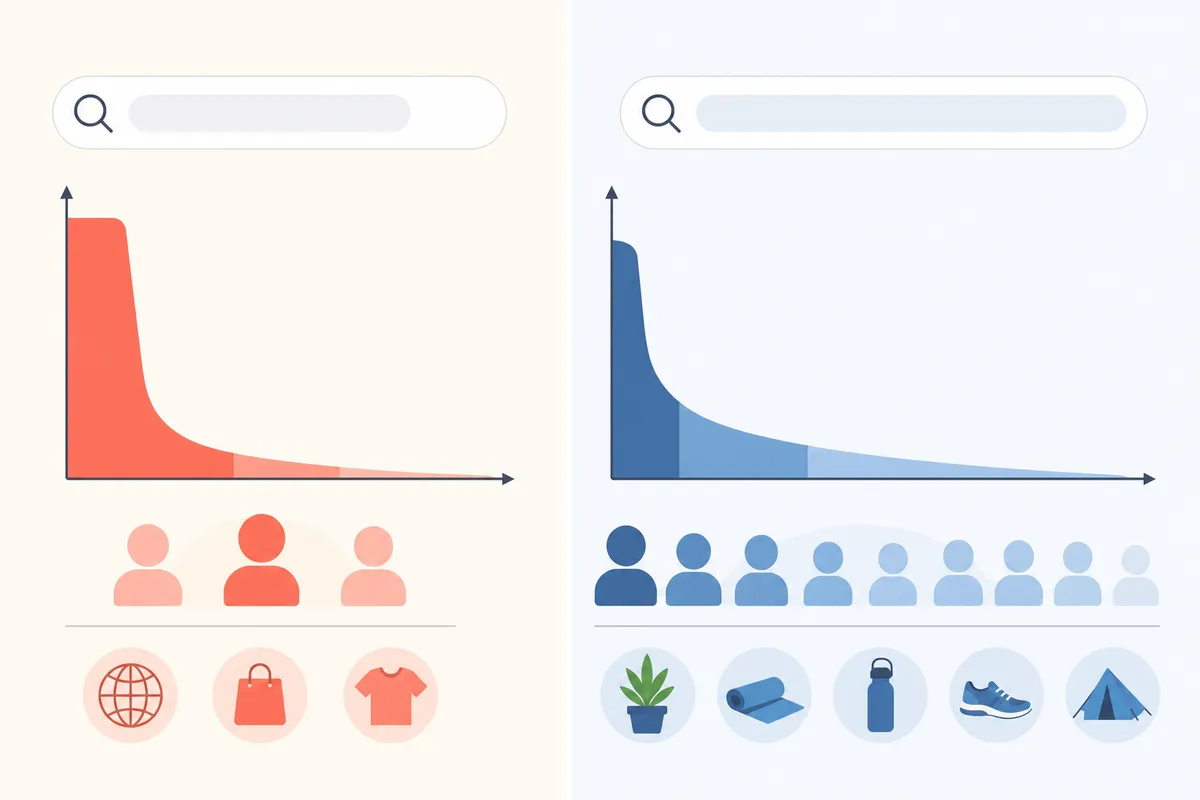
Short-tail keywords get all the attention because the volume numbers look impressive, but they're a small slice of total search demand. If you plotted every search query by volume, most terms would sit far out on the "tail" of that curve. Individually they're tiny, but enormous in total. That's actually where the name comes from. It's a reference to that demand curve, not to how many words the keyword contains.
Semrush's own keyword research turned up a real example of this. A group of long-tail variations had volumes as low as 30 searches a month each. Together, those added up to a collective 980 monthly searches once grouped onto one page. No single phrase in that cluster would justify its own page, but the cluster together is worth building for.
AI search makes the long tail matter even more. AI Overviews, Google AI Mode and chat assistants work by breaking one question into several related sub-questions before composing an answer. That process is often called query fan-out. The more long-tail variations your content covers around a topic, the more of those sub-questions it can match. A page built as one clear question per heading, followed by one self-contained answer, gives these systems a cleaner passage to lift. That beats a page that only addresses its topic in general terms. You can watch this cluster effect in your own data too. A site traffic view that pulls together Google Analytics, Search Console and AI visits will show a long tail of small queries. Those queries drive more combined sessions than your top two or three head terms.
Which Keyword Type Should You Target First?
The right starting point depends on where your site stands today, not on which keyword type sounds more appealing.
| Site situation | Recommended focus | Why |
|---|---|---|
| New site or low domain authority | Long-tail keywords | Lower competition means faster, real wins instead of years waiting on a head term |
| Established site with existing backlinks | A blend, leaning short-tail | Head terms pay off once you have the authority to compete for them |
| Local or service business | Long-tail with location and service modifiers | Matches near-me, ready-to-buy searches directly |
If you're just starting out, a handful of long-tail wins will do more for your business. That beats one unranked attempt at a head term. As those pages earn links and authority, you can layer a short-tail page on top of the cluster you've already built. A written SEO plan that sequences which term to chase first keeps that order deliberate. That beats chasing whatever keyword looks biggest on a spreadsheet.
How Short-Tail and Long-Tail Keywords Work Together
Neither keyword type works best alone. The most durable structure pairs a short-tail hub page, built around the broad head term, with several long-tail spoke pages. Each spoke answers one specific version of the question. The spokes link back to the hub, and the hub links out to every spoke. That way, the whole cluster reinforces itself in the eyes of both searchers and search engines.
This is also where keyword research earns its keep. A free keyword and SEO tool can turn one broad head term into dozens of specific spoke ideas. Each comes with its own search volume, before you commit to writing a single page.
How to Find Long-Tail Keywords That Are Worth Targeting
A few sources consistently turn up usable long-tail keywords:
- Autocomplete and "People Also Ask." Typing a seed term into Google surfaces real phrasing people search, and PAA boxes hand you ready-made questions.
- Your own rankings. Check Google Search Console for queries where you already rank in positions 11 to 20. That's content close to a page-one breakthrough, not a page needing a rewrite.
- Competitor keyword gaps. Run a competitor's domain through a keyword tool filtered to low volume and low difficulty. You'll usually find phrases they rank for almost by accident.
- Reddit, Quora and AI chatbots. These surface the exact conversational language your audience uses, including phrases with no measurable search volume in standard tools. Voice search and AI chat interfaces generate long, natural questions that databases often can't track accurately, which doesn't mean nobody's asking them.
Turning Long-Tail Keywords Into Content That Ranks
Group related long-tail phrases by intent and build one solid page per cluster. That beats a separate thin page for every close variation. Write the keyword into the title, the opening paragraph and a subheading or two, naturally. Then let variants and related phrasing carry the rest of the page. Once a page is live, rank tracking for the keywords you're working to win tells you whether it's climbing toward page one. Or whether it needs another pass.
FAQs
What is a short-tail keyword in SEO?
A short-tail keyword is a broad search term of one to three words, such as "shoes" or "digital camera." It draws high search volume but also the most competition, and the searcher's intent behind it is often unclear.
What is a long-tail keyword in SEO?
A long-tail keyword is a longer, more specific search phrase, typically three or more words, like "running shoes for flat feet." It draws fewer searches than a short-tail term but attracts visitors with a much clearer, often closer-to-buying intent.
How many words is a long-tail keyword?
Three or more words is the usual guideline, but there's no fixed cutoff. What actually makes a keyword long-tail is low search volume and high specificity, not a strict word count.
Are long-tail keywords better than short-tail keywords?
Neither is universally better. Long-tail keywords are easier to rank for and typically convert at a higher rate. Short-tail terms bring in far more total volume. Once won, they often rank a page for hundreds of related phrases at the same time.
Should I target long-tail or short-tail keywords first on a new site?
Start with long-tail keywords. They face less competition, so a new or lower-authority site can realistically rank for them within weeks rather than years. Short-tail terms become worth chasing once you've built authority from those long-tail wins.
Build Your Keyword Mix Around What Your Site Can Actually Win
Long-tail keywords and short-tail keywords both have a role here. Pick two or three long-tail clusters tied to what your business actually sells, and write one solid page per cluster. Track how each one moves before you spend months chasing a short-tail term your site isn't ready to compete for yet. If you want to see what that keyword mix looks like mapped against your own site, talk to the team.
Sources
About the author
SearchBlueprint researched, wrote and scored this article with the content pipeline our customers run on their own sites. The score in the byline is what our content engine gave this page before it published. Nothing here is reviewed by hand, which is the point: it is the product's output, published where anyone can check it.